

Fact Checked & Updated by Shea Brogren, MOT, OTR/L
Are you wondering if (and how) weighted blankets work for anxiety?
If so, you are in the right place. :)
In today's post we will answer the following:
- Do weighted blankets work for anxiety?
- If they do, how do they work?
- If a weighted blanket for anxiety seems right for me, what do I need to know about getting one?
**Note** This post was revised by Shea Brogren, MOT, OTR/L for accuracy
- What is a Weighted Blanket?
- Weighted Blankets & Anxiety: The Science
- Effects on Serotonin & Calmness
- Effects on Cortisol & Stress
- Effects on the Nervous System
- Effects on Sleep
- How to Choose a Weighted Blanket
Weighted blankets have exploded in popularity in the last couple of years. Heavy blankets have actually been used for a while, but are finally getting a larger notice because of the impact they can have on people, specifically children and adults with high anxiety levels and anxiety disorders.
Weighted blankets have typically been used for those with special needs, like autism, ADHD, and sensory processing disorder. However, anxiety and sleeping problems are issues that weighted blankets can make a big impact on as well.
Before we dive into the research regarding weighted blankets and anxiety, let’s take a quick look at what a weighted blanket is, in case you are new to them.
What is a Weighted Blanket?
A weighted blanket is a specific blanket that  is designed to be heavier than a regular blanket. They can come in a variety of weights and sizes. They are also made differently by different companies.
Depending on your needs, you’ll want to get a weighted blanket that suits you. We cover more on how to find the right weighted blanket at the end of the article.
While you may not have ever used a weighted blanket, there’s a chance you have already noticed the benefits of what a weighted blanket can do. By this, I mean that often times people will put a lot of blankets on themselves to get a designed “heavy” feeling. Also, even a big hug has similar effects to what weighted blankets can do.
Weighted Blankets for Anxiety: The Science of Why They Work
There is an underlying science behind weighted blankets. It’s called Deep Touch Pressure or DTP.
DTP is simply a gentle, distributed pressure on the body. It can be accomplished through weighted blankets, weighted compression vests, weighted lap pads or stuffed animals, massages, or even hugs!
Here are a couple of science-backed benefits of DTP.
Increased Serotonin For Improved Calmness

One of the reasons why DTP works is because it has been shown to increase serotonin in the body. Serotonin is a chemical in the body that works in conjunction with other hormones to decrease blood pressure, heart rate, anxiety, and regulate mood. This ultimately has a calming effect on the body.
Decreased Cortisol for Improved Stress Levels
In addition to increasing serotonin levels, DTP has also been found to reduce cortisol levels in the body. Cortisol is a hormone that regulates stress responses in the body. High levels of cortisol are associated with high levels of stress and the use of a weighted blanket can actually decrease these stress hormones in the body. This can lead to an improved mood, more efficient sleep, and feeling better physically.
Weighted Blankets Reduce Activity in the Nervous System
On top of that, weighted blankets have specifically been shown to decrease the activity in the nervous system. This is due to the effects on the vagus nerve, which is involved in regulating heart rate and blood pressure. One study found this when studying people who have anxiety in the dentist's office.
Another study found that physiologically, 33% of people using a weighted blanket had decreases in their nervous system activity, such as pulse rate and blood pressure, while 63% reported having lower anxiety. Overall, 78% of people in the study preferred the weighted blanket as a tool to relieve anxiety.
A study that looked at DTP through the use of a weighted vest found that using the weighted vest “for even short periods of time reduced sympathetic arousal and non–stimulus-driven electrical occurrences.” This basically means that their body had physiological changes as it calmed down because of the weighted blanket.
Weighted vests for anxiety are also gaining in popularity, as it's a version of a weighted blanket that you can use on the go.
Weighted Blankets Promote Restful Sleep
Often times, sleeping will be a major problem for those that suffer from anxiety. This can come from not being able to calm down as well as not being able to slow down the running thoughts in one’s head. One study found that people who used weighted blankets have calmer nights of sleep, with a reduction of movement.
The participants noted that they had a more comfortable, deeper sleep. Again, this is due to increased serotonin levels. Serotonin is linked to melatonin, which is the chemical in the body that regulates our sleep/wake signals. When serotonin levels are optimal, this signals melatonin to do its job, which is managing sleep patterns.
It doesn’t really matter where your anxiety arises from, it appears that a weighted blanket could help you reduce it and get better sleep. Whether it’s autism, restless leg syndrome, PTSD, OCD, or bipolar, using DTP to increase serotonin can have a very positive effect on those health conditions.
How to Choose the Right Weighted Blanket for You?
Often times, weighted blankets are a bit of an investment. This means that you’ll want to make sure you choose one that fits your needs. Let's take a look at what you need to consider:
What Weight Should You Get for Your Weighted Blanket?
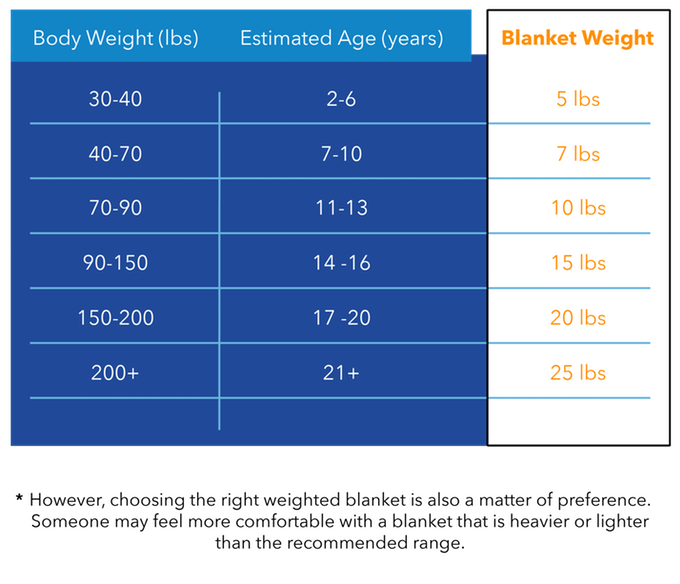
The first question is how to choose the right size weighted blanket. The rule of thumb for this is 10% of your body weight plus a pound or two.
If you weigh 150 pounds, you’ll most likely want a blanket that weighs 16 to 17 pounds. If you are buying a weighted blanket for a young child that weighs 30 pounds, then a 4 to 5-pound blanket is what you’ll want.
How Should Your Weighted Blanket Be Made?
You’ll want to look at the filling of the blanket. Some companies use food, like rice or barley to fill blankets. If the person you are buying the blanket for has allergies or sensitivities, then you’ll want to find a blanket that has a more neutral filling.
For example, we use part cotton and part glass beads to fill our blankets. This way, there are no food sensitivities to worry about.
The design of the blanket is important to look at as well. Is the blanket easy to wash? Some blankets come with a detachable duvet cover that helps with quick and easy washing.
Is the weight evenly divided into sections, or are you going to have to worry about the weight sliding all to one side?
How Big Should Your Weighted Blanket Be?
The last thing you’ll want to look at is the dimensions. It’s important to keep in mind that a weighted blanket should be smaller than the size of your bed. It’s designed to sit on top of the bed, so it doesn’t slide off to one side.
If you need more information about weighted blankets, feel free to ask us in the comments. We love to help families find the right blanket.
Conclusion
There you have it! The science backing up the use of weighted blankets for anxiety. If you have any questions, please ask us in the comments!


27 Responses
Concern on weight of blanket. I am 59 and weight 325. if I followed thecrule of thumb the blanket would be very heavy. Too expensive to just guess, but that seems too heavy. How do I choose?
Could you please give me a name/s of a good weighted blanket that is not stuffed with food? Thank you!
Randi
Hey Phillip,
While we haven’t research the effects of Deep Pressure on animals, I would assume you’re on to something by comparing the two!
Would be something interesting to look into.
Thanks for your comment,
Casey
Founder of Harkla
Does this follow the same train of thought behind the use of “thunder coats” for nervous dogs? It seems like there’s a parallel here with how dogs are being treated for anxiety.
Leave a Comment