

One of the biggest issues for people with autism is sleeping problems. This is actually a very common issue autistic children and adults have, and if fixed can have a positive effect on a lot of aspects of their lives.
We all know how we can become irritable when we don't get a good night's sleep. If your autistic child is continuously having trouble falling and staying asleep, think about how that affects their behavior every single day!
With that in mind, we wanted to write the ultimate guide on autism and sleep issues, and how to help your autistic child sleep better. We cover why sleep is important for your special child, what sleep medications can help, and how to set up a routine for success!
If you have any questions or comments to add, please let us know in the comment section.
Key Takeaways
-
Over 80% of children with autism experience sleep problems, which can significantly affect their behavior, mood, and overall well-being.
-
Lack of adequate sleep can lead to irritability, mood changes, behavioral issues (such as hyperactivity or aggression), and difficulties with learning and memory. Sleep deprivation can worsen existing autism-related symptoms.
-
Children with autism often have irregular melatonin levels, which disrupt their sleep-wake cycle and make it harder for them to fall asleep. This is linked to circadian rhythm disturbances.
-
Issues like frequent night awakenings, difficulty falling asleep, and reduced REM sleep are common in children with autism. These sleep disturbances are often more pronounced as children age.
-
Practical strategies like establishing a consistent bedtime routine, reducing screen time before bed, using weighted blankets, and considering dietary adjustments (e.g., magnesium-rich foods) can significantly improve sleep quality for children with autism.
-
Sensory sensitivities, such as sensitivity to light and noise, can disrupt sleep. Creating a calming sleep environment (e.g., using blackout curtains, white noise machines, or red-hued nightlights) can help manage these sensitivities and promote better sleep.
Sleep deprivation

If your child is not getting the recommended amount of sleep, the effects can compound and sleep deprivation can result.
The National Sleep Foundation recommends that preschool children receive 11-13 hours of sleep each night, school-age children 10 -11 hours, and teenagers 8 - 10 hours. Because the recommended sleep time decreases with age, the recommendation for adults is 7-9 hours of sleep per night.
Side effects of sleep deprivation can include:
- Irritability, mood changes
- Daytime drowsiness
- Behavioral issues: hyperactivity, aggression, inattentiveness
- Difficulties with organization, planning, judgment
- Difficulties with new learning & retention of learned skills (memory)
- Decreased safety awareness
Why Might My Child Struggle to Sleep?
There are several factors that contribute to sleep difficulties in children with autism:
-
Difficulties Settling: Many autistic children have trouble winding down and getting to sleep.
-
Frequent Night Awakenings: Children often wake up multiple times during the night and may struggle to return to sleep.
-
Increased Anxiety: Anxiety can make it hard for your child to relax and fall asleep.
-
Sensory Sensitivities: Light, noise, and other sensory factors can disrupt sleep. For example, sensitivity to blue light from screens or certain noises can make it harder for your child to fall asleep.
How Autism Affects Sleep
Research suggests that autism may cause irregularities in the circadian rhythm, the body's natural sleep-wake cycle. Autistic children may experience delayed melatonin production at night, which makes it harder for them to feel sleepy. Additionally, genetic mutations in circadian genes might contribute to sleep disruptions. Sensory sensitivities, such as heightened reactions to light, sound, or textures, can also interfere with their ability to fall or stay asleep.
What are the Common Sleep Disorders in Children with Autism
Autism Speaks estimates that over 80% of children with autism have sleep problems.
Researchers are working hard to uncover exactly why the incidence of sleep disorders is so high in autistic children: Does the neurological and genetic makeup of the autistic brain and body contribute to sleep issues? Or, are issues with sleep contributing to commonly observed symptoms, behaviors, and learning difficulties associated with autism?
Less Time Spent Sleeping
In a study published in the Archives of Disease Control, it was reported that children with autism, aged 30 months to 11 years old, slept for 17-43 minutes less per day than their peers. The shortened sleep times were attributed to later bedtimes, earlier wake times, and night awakening (3+ times per night).
As the age of the research participants increased, the problems with night awakening increased as well (11% of children with ASD versus .5% of children aged 6.75 years). Sleep deprivation is thought to exacerbate some of the social, behavioral, and cognitive skill issues associated with autism.
Less Time in REM Sleep Cycles
Research has also indicated that children with autism spend less time in the critically-important REM sleep cycle than other peers (15% compared with 23%). Since this is the restorative phase of sleep where the day’s information, experiences, and memories are consolidated, researchers are examining the role this lack of REM-sleep plays in the learning difficulties associated with autism.
Difficulty Falling Asleep
Another common sleep problem with children with autism is difficulty falling asleep. Each of our bodies has a 24-hour sleep-wake pattern called a circadian rhythm. These circadian rhythms are controlled by the hypothalamus of your brain and are essential to falling asleep and waking in a regular timeframe.
The hypothalamus controls the brain’s release of melatonin, which helps your body become tired. Research has found that people with autism have elevated melatonin levels during the day, and lower levels of melatonin at night - this is the opposite of what should be the case.
This dysregulation of melatonin levels can contribute to a disruption of the body’s circadian rhythm, meaning parents have to work extra hard to make a non-drowsy child ready for bed!
Additionally, researchers are examining the role that genetics plays in the autism-sleep relationship. Recent research has found more than twice the genetic mutations of circadian genes in people with autism. Scientists continue to explore what mutations are indicators of sleep disorders and whether or not these specific mutations are unique to autism or found in other neurotypical sleep-disordered people.
If you haven’t realized by now, there is no easy answer for figuring out the origination and/or solutions for sleep disorders! To further complicate the issue, children with autism have additional considerations when looking at what could contribute to sleep disturbances:
- Comorbid diagnoses like anxiety, restless leg syndrome, epilepsy
- Side effects of medication(s)
- Neurological diagnoses
- Sensory dysregulation
- Gastrointestinal problems
- Behavioral rigidity associated with a bedtime routine
Now that we've covered what sleep issues those with autism may be having, let's get into ways to improve them.
How Are Sleep Problems Diagnosed?
Diagnosing sleep problems in children with autism often involves:
-
Sleep Diaries: Keeping track of sleep patterns, routines, and disruptions can help identify potential causes.
-
Sleep Studies: In more severe cases, doctors may recommend a sleep study (polysomnography) to monitor sleep stages and detect disorders like sleep apnea or restless leg syndrome.
-
Actigraphy: This is a noninvasive method that tracks movement patterns during sleep, helping identify circadian rhythm issues.
11 Tips on How to Get Your Autistic Child to Sleep
 Finding the right combination of tools, strategies, and routines will take some trial and error.
As you trial sleep tools and make changes to routines and environments, be sure to keep a sleep log or sleep journal. Subtle changes can have drastic effects on your child’s behavior, so keep track of your observations by writing it down.
Consider jotting down diet changes, bedtime adjustments, the frequency of wake-ups, wake-up times, and behaviors completing the bedtime routine.
Even small changes can add up to a big difference over time and it’s too easy to lose sight of your efforts without the written log.
1) Melatonin for Autism Sleep Issues
Some doctors and parents are combining behavioral approaches to sleep issues with over-the-counter melatonin. Melatonin is a hormone that is naturally produced by the pineal gland during the sleep cycle and it has been used as a supplement to treat sleep disturbances in kids with ADHD and autism.
A study in the 2008 Journal of Child Neurology researched the effects of melatonin in the treatment of insomnia in children with autism and found that 60% of parents reported improved sleep. The 2006 Journal of Autism and Developmental Disorders reports that long-term melatonin treatment was effective overall and no safety concerns were found for continuing melatonin treatment.
As with all over-the-counter medications, you want to ensure the correct dosage for your child. Believe it or not, melatonin is not regulated by the Food and Drug Administration (FDA) so the dosages vary by manufacturers and medication form (pill, liquid, dissolvable lozenge).
Because some children with autism are also on psychotropic medications, finding the right dose of melatonin can be a tricky task so it’s best to work with your pediatrician to consider all of the variables that are specific to your child.
According to Dr. Craig Canapari, director of Yale Pediatric Sleep Center, “In general, I would start at a low dose (0.5–1 mg) and increase slowly. Recognize that melatonin, unlike other medications, is a hormone and that lower doses are sometimes more effective than higher ones, especially if the benefit of it reduces with time.”
2) Assess your existing bedtime routine
Establishing a consistent bedtime and bedtime routine can help your child begin to calm himself down. This routine is important for all children, but even more so for children with autism.
A warm (not hot) aromatherapy bath, short story, and lotion massage can help offer calming sensory input while providing visuals of the routine supports predictability and understanding.
3) Take a close look at what your child is eating
You may be surprised at the sugar content in common kids' snacks! As adults, we’re mindful of limiting sugars and caffeine as we approach bedtime, but don’t forget to consider how your child’s diet may be impacting their sleep readiness. Also, be mindful of the nutrients that are lacking in your child’s diet. Foods that contain tryptophan, magnesium, calcium, vitamin B6, and naturally-occurring melatonin may be helpful additions to your child’s dinnertime meal! Magnesium, in particular, can help improve sleep by promoting relaxation and calming the nervous system. This is especially helpful for children with autism, as magnesium supports the regulation of melatonin, the hormone that signals it's time to sleep. Adding magnesium-rich foods like leafy greens, nuts, and seeds to your child’s diet can support better sleep and help them feel more relaxed before bed.
4) Improve Day and Night Time Lighting
Natural and environmental lighting plays a role in our sleep-wake cycle and it’s not always a positive effect! Certain kinds of lighting affect one’s arousal level more so than others.
For example, daylight and fluorescent lighting are stimulating. Limiting screen time 2 hours prior to bedtime and avoiding brightly lit rooms will help regulate your child’s circadian rhythm.
Research has supported that red-hued bulbs do not affect the circadian rhythms, so if a nightlight is needed, consider swapping out the typical bulb for a red-hue.
5) A Special Autism Bed Tent

Companies are now making enclosed beds, or bed tents, which provide a contained, cozy, safe space for sleep.
There are many styles – separate free standing units, pop-up types that rest on top of the mattress and after-market canopies that strap to the bed frame itself. Some are inflatable, portable and easy to assemble.
You can find bed tents with varying safety measures built in to prevent elopement.
Some of these beds for autism can be bolted to the floor, or easily moved within the room, while others allow more flexibility for travel, allowing families to potentially spend a night in a hotel, or at grandmas house.
If you really want a top of the line bed, the company to check out is Cubby Beds! They create "smart beds" that has almost all of the features a parent could want for their child with autism.
Their beds have circadian lights built into them to help mimic natural lighting, soothing speakers for a calming environment, and even a monitoring camera!
Since these are top of the line, the price is pretty high, but they do a great job working with insurance companies to get a decent portion of the bed covered.
6) Consider your child’s bedroom environment
From the window coverings to the colors on the walls, and the noises in between. Your child’s bedroom should be a calming retreat that offers sensory deprivation when it’s time to calm down.
A white noise machine can help filter out some of the extraneous hallway or outdoor noises that may be disruptive to your child falling or staying asleep.
Black-out curtains or roller shades are effective ways to block excess light from peeking through the window to wake your child up earlier than needed!
Darker colors on walls will foster better sleep than lighter colors, so consider repainting in a darker hue that won’t reflect the light as much.
7) Add-In a Sensory Diet and Exercise
All of these sensory activities promote regulation and the hormones released are also involved in sleep. So, encourage sensory activity throughout the day to support your child’s sleep patterns but be mindful of stopping alerting sensory activities one hour prior to bedtime.
You can read our article here with more information on sensory diets.
8) Aromatherapy & essential oils
Lavender, vanilla, chamomile can be used in bedtime sprays, lotions, and essential oil baths to promote calm and relaxation before bed. Using a diffuser is a great way to help spread the essential oils if your child enjoys the smell.
9) Consider your child’s bedding
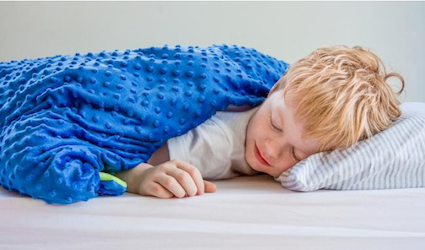
The textures of the sheets, pillows, and comforters should be sensory-preferred and snuggly soft.
Some parents find that oversized pillows or stuffed animals offer additional sensory input for squeezing, hugging, and burrowing. For many children on the autism spectrum, burrowing into blankets, pillows, or even hiding under sheets provides a soothing effect. This behavior is often linked to sensory needs, where deep touch pressure helps children feel secure and calm. Burrowing can also support self-regulation, helping manage overwhelming sensory input at night.
Consider a heavy duvet/down comforter or a specifically-designed weighted blanket.
Weighted blankets have been found to offer deep touch pressure which can positively impact sleep behaviors.
Another option that provides deep touch pressure is a sensory compression sheet. These sheets wrap around the bed and offer compression to the child. Often times, it's hard to customize the amount of compression your child is getting, but they are more breathable than a weighted blanket.
The choice between a weighted blanket and a compression sheet would depend on your child's preferences.
10) Get a Sleep Smart Alarm Clock
If your child has difficulty knowing when it’s officially “wake-up” time or oversleeping, try adding a sleep-smart alarm clock that specifically targets their needs.
OK to Wake Alarm Clock - Good for kids who wake up early and need to learn to wait in bed until a reasonable hour! This clock glows a green color when it’s wake up time (you set the time).
Wake Up Light - Good for kids who have trouble waking up. This alarm clock simulates a natural lightening when it’s time to wake. Another bonus is that it can act as a nightlight in any color hue (including red!)
11) Increasing Natural Light-Exposure During the Day
More natural light is very good for our natural cardiac rhythms and can improve our sleep cycles at night. Schedule 10 minutes of outdoor play in the early morning, noon, and at dusk.
Explore the use of a lightbox as a tool for light therapy. This is especially helpful in the winter months or if you live in an area that isn’t rich in sunshine year-round!
Co-Sleeping and Autism
The desperation of sleepless parents is a reality that forces many families to resort to co-sleeping with their child in a last-ditch effort to get some shut-eye. If your child is known to climb out of his crib in the middle of the night or wander around the house while the rest of the family is fast asleep, co-sleeping offers peace of mind and an element of safety.
It’s an understandable and common adjustment that families often make out of resignation and frustration.
If you choose a family bed, keep in mind that your sleepless child with autism will soon become a teen... and then an adult! It will get more difficult to accommodate a larger body in bed with you, especially if behavioral issues associated with sleep disruptions escalate over time.
Consider consulting with a behaviorist who can come into your home and work with your family to identify alternate solutions or a way to move from the family bed to another sleep setup. Sometimes recommendations are made for a cot, sleeping bag, or mattress placed adjacent to the parent’s bed to transition the child to a more independent sleeping arrangement in a gradual way.
Autism Sleep Study
If you are interested in seeking more information about exactly what your child’s sleep patterns are, there are sleep centers that will conduct sleep studies. While these tend to be more invasive and a last-resort for families, they do offer helpful insight and possible additional solutions.
Final Thoughts
Sleep is a complex issue that doesn’t always have an easy one-size-fits-all solution, especially when you’re a child on the autism spectrum. Fortunately, there are many sleep-specific resources and products available to help you create your own sleep tool-kit.
Finding your just-right sleep solution might be a lot like picking out your new mattress, though -- you may have to try a bunch before you find the right one! Let us know what sleep strategies work for you.
Frequently Asked Questions
Does autism cause sleep issues?
Yes, sleep issues are very common in children with autism. Autism can affect the body's sleep-wake cycle and lead to difficulties falling asleep, staying asleep, or getting restful sleep. Sensory sensitivities, anxiety, and other factors may also contribute to these sleep challenges.
Do autistics need more sleep?
Children with autism may need more sleep than neurotypical children because of the challenges they face with sleep quality. However, they often get less sleep due to issues like difficulty falling asleep and frequent awakenings during the night. The recommended sleep duration for autistic children is the same as for other children, but they may need extra support to get restful sleep.
At what age do sleep problems start with autism?
Sleep problems can begin as early as infancy or toddlerhood in children with autism. Many children with autism experience sleep difficulties as early as 6 months old, with issues often continuing through childhood and into adulthood. The severity and type of sleep problems can vary with age and development.
What is the best sleep schedule for autism?
A consistent sleep schedule is key for children with autism. Going to bed and waking up at the same time each day helps regulate the body’s circadian rhythm. It’s also important to create a calming bedtime routine and reduce stimulating activities, like screen time, before bed. A quiet, dark environment can also help promote better sleep.
Do autistic kids like to sleep alone?
Every child is different, but many children with autism prefer to sleep alone because they feel more comfortable in their own space. However, some autistic children may experience anxiety or fear about sleeping alone. In these cases, it's important to provide reassurance, establish a consistent bedtime routine for the autistic child, and create a calming sleep environment. It may take time for your child to feel comfortable sleeping alone.
Facebook Live Session with The Pocket OT on Autism and Sleep
Do you learn better with video? We had Cara Koscinski from The Pocket OT do a special Facebook Live about sleeping issues and autism. Here is a replay for you to dive even deeper into the subject
Video Notes:
2:18 Poor sleep impairs our physical and psychological well being.
2:34 Sensory system issues affect sleep.
3:50 Transitioning to sleep from a busy day is difficult.
4:31 Start a sleep routine about an hour before bed.
5:00 Visual schedules are helpful (PECS).
6:40 Take pictures of your child doing bedtime routine activities.
7:30 Do2Learn.com has pre-made visuals.
8:00 Set the example for your child by having a bedtime routine.
9:00 Help your child relax with calming techniques.
10:00 Weighted blankets can help your child relax.
10:50 Linear swinging and rocking can be relaxing.
12:10 Talk to your child's doctor about melatonin.
15:50 Light from video games cause wakefulness.
17:20 Choose colors, scents, and sounds that are calming.
20:00 Spa-like environment for your child.
Check out our YouTube video about 5 Tips for Bedtime!


1 Response
Thank you for this information I only wished I had come across it sooner.
My son is 23 and his anxiety and insomnia is getting worse. He strugglele with any change in his routine or disruption so painting his room is very challenging for him and it really needs doing. I would like to be able to help him make his bedroom relaxing and calming. I’m sending him this website link and hopefully he will find it helpful.
Leave a Comment